
Avid Pro Tools is built for detailed audio work, but when you are working against a deadline, recording multiple takes, editing dialogue, cleaning up a drum performance or making hundreds of small changes to a mix, the mouse can quickly become a bottleneck. Constantly moving between the Edit window, Transport controls, menus and individual clips takes time, and those small movements can add up considerably over the course of a session.
Learning the most useful Pro Tools keyboard shortcuts gives you a much faster way to work. Instead of reaching for a menu every time you need to perform a common task, you can keep your attention on the audio and make many of the commands you use dozens or hundreds of times during a project almost instantaneously.
There are a huge number of Pro Tools keyboard shortcuts, but you do not need to memorise all of them to make a significant difference to your workflow. The ten shortcuts below cover some of the most useful operations for recording, editing, navigation and session management, making them particularly valuable for engineers who spend long hours working inside Pro Tools.
The shortcuts below use the Mac commands where applicable, with the Windows equivalent included alongside them. Some Pro Tools commands can also depend on keyboard focus, the current Edit mode or whether features such as Tab to Transients are enabled, so it is worth becoming familiar with how your particular session is configured.

1. Start Recording – Command + Spacebar
When you are tracking vocals, guitars, drums, keyboards or any other live source, starting and stopping recording is something you may do hundreds of times during a session. Pro Tools gives you several ways to begin recording, but Command + Spacebar on Mac is one of the most useful shortcuts to learn, with Control + Spacebar performing the same function on Windows.
Once your tracks are record-enabled and your session is ready, Command + Spacebar lets you start recording without moving your hand to the Transport window. Press Spacebar to stop recording when the take is finished.
This becomes particularly useful during vocal sessions, where an engineer may be starting another take every few minutes. Keeping the transport under keyboard control means you can stay focused on the artist, the Edit window and the session rather than repeatedly reaching for the mouse.
The shortcut is also useful when working with punch-ins. Once you have positioned the edit cursor or selection at the required point, you can initiate recording from the keyboard and keep your workflow moving. Pro Tools also supports Command + Shift + Spacebar for half-speed recording on Mac, although the standard recording shortcut is the one worth committing to muscle memory first.
If you regularly record in Pro Tools, this is one of the first shortcuts worth learning because it can become part of your basic tracking routine.
2. Tab to Transients – Tab
Tab to Transients is one of the most useful editing features in Pro Tools, particularly when working with drums, percussion, dialogue and other audio containing clearly defined transients.
With Tab to Transients enabled, pressing Tab moves the Edit cursor to the next detected transient in the waveform. On Mac, Command + Option + Tab toggles Tab to Transients on or off. On Windows, the equivalent is Control + Alt + Tab.
This can dramatically speed up the process of finding the exact start of a drum hit, consonant, guitar note or other important point in an audio recording. Rather than zooming in and manually positioning the cursor with a mouse, you can move through the waveform using the keyboard.
For example, imagine you are editing a multi-microphone drum recording and need to separate a series of kick drum hits. With Tab to Transients enabled, you can move through the performance from transient to transient and make precise edit decisions much more quickly.
Tab is also extremely useful when combined with Shift. Pressing Shift + Tab extends the current selection to the next transient, allowing you to build an audio selection directly from the keyboard. Option + Tab on Mac moves backwards to the previous transient, while Control + Tab performs the equivalent operation on Windows.
Once you become comfortable with Tab to Transients, it can fundamentally change how quickly you navigate audio in Pro Tools.
3. Separate Clip – Command + E
Command + E on Mac, or Control + E on Windows, separates a clip at the current Edit cursor or selection. This is an essential shortcut for practically anyone doing detailed audio editing in Pro Tools.
Consider a vocal recording containing a mistake, unwanted noise or a section that needs to be moved. Rather than reaching for the Edit menu, you can place the cursor at the required point and press Command + E to split the clip immediately.
The shortcut becomes even more powerful when combined with Tab to Transients. You can use Tab to find the exact transient or edit point, press Command + E to separate the clip, move to the next point and repeat the process. This creates a very fast workflow for chopping drums, tightening performances, editing dialogue and removing unwanted sections of recordings.
For drum editing, for example, you might use Tab to Transients to locate each kick or snare hit before using Command + E to create individual clips. For dialogue editing, the same combination can be used to quickly isolate words, phrases or unwanted noises.
Because separating clips is such a common operation, Command + E is one of the shortcuts that can quickly become second nature.
4. Add a Fade – Command + F
Clicks and pops at edit points can be a nuisance when editing audio. Even when two clips appear to meet perfectly on the timeline, an abrupt change in waveform can sometimes create an audible click. Adding a short fade or crossfade is therefore a routine part of many editing jobs.
Command + F on Mac, or Control + F on Windows, opens the Fades dialogue for the current selection. From there, you can create the appropriate fade or crossfade for the edit. The shortcut is particularly useful after separating and rearranging clips. If you have chopped a vocal, moved sections of dialogue or edited individual drum hits, you can quickly select an edit point and create a fade without having to navigate through the menus.
For engineers performing large amounts of editing, the benefit is cumulative. If a session contains dozens or hundreds of edit points, being able to access the fade command immediately can save a considerable amount of unnecessary mouse movement.
It is also worth learning the relationship between Command + E and Command + F. Separating clips allows you to make the edit, while fades help you make that edit sonically transparent. Together, these commands form an extremely useful pair for detailed audio editing.
5. Save Session – Command + S
Command + S on Mac, or Control + S on Windows, is one of the simplest shortcuts on this list, but it is also one of the most important.
Audio sessions can contain hours of recording, hundreds of clips, complex routing, plug-in settings, automation and detailed editing decisions. Losing recent work because a session has not been saved can be extremely frustrating, particularly during a long recording or mixing session.
Command + S allows you to save the current session without leaving the keyboard. Getting into the habit of saving regularly is especially useful after completing a significant edit, finishing a vocal comp, making substantial routing changes or reaching an important stage of a mix.
It is easy to overlook basic shortcuts because they are so familiar, but session management is part of an efficient engineering workflow. A good shortcut is not necessarily one that performs an elaborate operation; sometimes the most valuable command is the one that protects the work you have already completed.
For anyone working professionally in Pro Tools, Command + S should be pure muscle memory.

6. Undo – Command + Z
Audio engineering involves experimentation. You might make an edit, change your mind, adjust a plug-in, move a clip or alter an automation pass and then decide that the previous version sounded better. Command + Z on Mac, or Control + Z on Windows, gives you an immediate way to undo the most recent action.
This is particularly useful during editing and mixing because it encourages experimentation without making every decision feel permanent. If an edit does not work, you can undo it and try another approach. If a processing change makes the track worse, you can step backwards and reassess it.
Pro Tools maintains an undo history, meaning you can step backwards through multiple actions rather than having to manually reconstruct the session. The important habit is simply knowing that Command + Z is immediately available whenever you need to reverse an action.
It is also worth learning the corresponding Redo command, Command + Shift + Z on Mac and Control + Shift + Z on Windows. Having both available means you can quickly move backwards and forwards while comparing different editing decisions.
For engineers working quickly, Undo and Redo are fundamental tools rather than emergency commands.
7. Play/Stop – Spacebar
Spacebar is arguably the most frequently used Pro Tools shortcut of all. It starts and stops playback, allowing you to audition edits, check recordings, listen to plug-in changes and move around a mix without touching the Transport controls.
Its importance becomes obvious during a busy session. You might make an edit, press Spacebar to hear it, stop playback, make another adjustment and immediately listen again. Repeating this process dozens of times is considerably faster when playback is always available under your hand.
Spacebar also works naturally alongside other shortcuts. You can position the cursor using Tab, make a selection, press Spacebar to audition it, make an edit with Command + E and then immediately play the result.
This combination of navigation, editing and playback is where keyboard shortcuts start to become genuinely powerful. Rather than thinking about individual commands, you begin to develop a continuous workflow where the keyboard controls much of the session.
8. Move Between Edit Points and Clips – Tab
Even when Tab to Transients is disabled, Tab remains a useful navigation command because it can move the Edit cursor between clip boundaries and sync points. This makes it useful for navigating a session without repeatedly clicking different points on the timeline.
For engineers working on dialogue, podcasts, sound design or heavily edited music sessions, large sessions can contain hundreds or even thousands of clips. Being able to move between them using the keyboard can make navigation substantially quicker.
Shift + Tab can also be used to extend a selection to the next clip boundary. This is particularly useful when you need to select a complete section of audio without carefully dragging the mouse across the waveform.
The important thing to remember is that Tab has different behaviour depending on whether Tab to Transients is enabled. With Tab to Transients switched on, it moves between detected transients; with it switched off, it can navigate between clip boundaries and sync points.
Learning both behaviours gives you a flexible navigation tool that can be adapted to the type of editing you are doing.
9. Return to the Start of the Session – Return
When working through a session, there are plenty of occasions when you need to get back to the beginning quickly. On Mac, Return moves the insertion point to the start of the session, while Enter performs the equivalent operation on Windows.
This can be particularly useful during tracking. If you are repeatedly checking the arrangement from the beginning, you do not need to drag the playhead back to bar one with the mouse.
It is also useful when moving between different parts of a project. After auditioning a later section, you can instantly return to the start and begin playback again. Combined with Spacebar, this creates a very simple keyboard-controlled transport workflow.
It may seem like a small shortcut, but navigation commands become increasingly valuable as sessions become larger. When a project contains dozens of tracks and hundreds of clips, reducing unnecessary mouse movements helps you maintain your concentration on the audio.
10. Zoom Toggle – Control + E
When editing detailed audio, being able to switch quickly between a close-up waveform view and a wider session view is essential. Pro Tools includes Zoom Toggle, which allows you to temporarily change the zoom level and then return to the previous view.
On Mac, Control + E activates Zoom Toggle, while Start + E is the Windows equivalent.
This is particularly useful when performing precise edits. You might initially be looking at an entire song or a large section of a recording, then need to inspect a small waveform detail to make a precise cut. Zoom Toggle gives you a fast way to move into a more detailed view and then return to the previous zoom level.
For engineers working on dialogue, noise removal, vocal editing and detailed musical performances, this can reduce the amount of time spent manually adjusting the zoom controls.
The key benefit comes from using it repeatedly as part of your editing routine. Instead of constantly dragging zoom controls or using the mouse wheel to find the right view, you can switch between broader session navigation and detailed waveform editing directly from the keyboard.

How Pro Tools Keyboard Shortcuts Improve Your Workflow
The real advantage of Pro Tools keyboard shortcuts comes from combining them rather than treating them as isolated commands. A typical editing task might involve pressing Tab to locate a transient, Shift + Tab to create a selection, Command + E to separate a clip, Command + F to create a fade and Spacebar to audition the result. Once these commands become familiar, a task that would previously involve repeated mouse movements can become a much more fluid process.
The same principle applies during recording. Command + Spacebar can start a take, Spacebar can stop it, Return can take you back to the beginning and Command + S can save the session. These are small actions individually, but an engineer may perform them repeatedly throughout a working day.

Keyboard shortcuts are particularly valuable when working under time pressure. Recording sessions often move quickly, and editing jobs can involve a huge number of repetitive operations. Reducing the number of times you have to reach for menus or move the mouse can leave you with more attention available for listening and making creative decisions.
There is also a significant muscle-memory benefit. The more frequently you use a shortcut, the less conscious thought is required to perform it. Eventually, commands such as separating a clip, starting playback or saving a session become automatic parts of your workflow.
Learn Pro Tools Shortcuts Faster with an Editors Keys Keyboard
Memorising a large collection of Pro Tools shortcuts can take time, particularly when you are learning the software or moving between different DAWs and editing applications. This is where a dedicated shortcut keyboard can be useful.
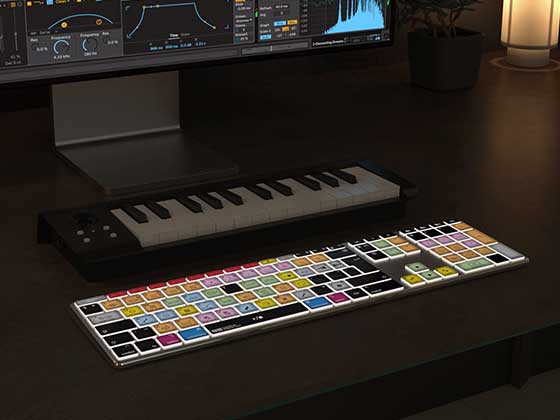
Editors Keys shortcut editing keyboards are designed with commonly used software commands mapped directly onto the keys. Rather than relying on a separate shortcut reference sheet or repeatedly searching through Pro Tools menus, the keyboard gives you a visual reminder of the commands while you work.
The colour-coded shortcut layout also helps make commonly used modifier combinations easier to recognise. Over time, seeing the commands directly on the keyboard can help reinforce the muscle memory needed to use them without consciously looking at the shortcut every time.

For Pro Tools users, this can be particularly useful when learning a new workflow. Instead of trying to memorise dozens of commands before you can start benefiting from them, you can keep the relevant shortcuts directly in front of you and gradually build familiarity through everyday use.
Editors Keys offers the AB10 range of shortcut editing keyboards, including Wireless and Wired USB-C Backlit models. The backlit design makes the keyboard particularly practical for studio environments where the room may be dimmed while recording or mixing.
The AB10 range is designed to make shortcuts easier to see and easier to remember, with software-specific commands mapped onto the keyboard for a more efficient editing workflow. Having the commands physically associated with the keys can help reduce the amount of time spent looking up shortcuts while you work.
For engineers who move between different applications, a shortcut keyboard can also make the transition between software environments easier. Editors Keys produces shortcut keyboards and silicone keyboard covers for a range of creative applications, allowing you to choose a layout designed around the software you use most.
Pro Tools Shortcut Keyboard Covers
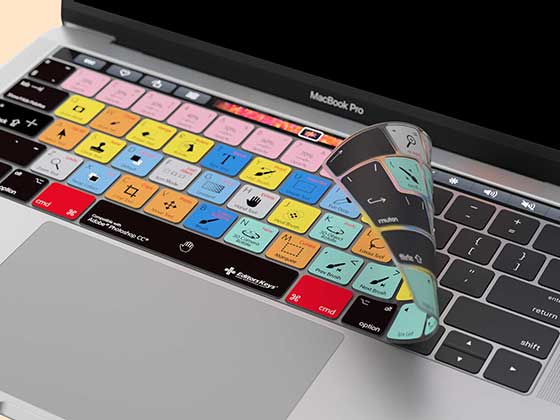
If you already have a keyboard that you like, a silicone shortcut keyboard cover can provide another way to bring software-specific shortcuts directly onto your desk. Editors Keys silicone keyboard covers are designed to sit over compatible keyboards while displaying the shortcuts for the software you use. They provide a physical reference for commands while also helping protect the keyboard from dust and light spills.
For someone learning Pro Tools, this can be a particularly convenient way to reinforce shortcut memory. Instead of keeping a shortcut cheat sheet next to the monitor, the commands are positioned directly over the keys you are using.

The covers are also useful for engineers who work with several applications. Switching between different shortcut layouts can otherwise mean constantly referring back to documentation, particularly when moving between audio, video and music-production software. A dedicated shortcut cover gives you a quick visual reference while you work.
Why Keyboard Shortcuts Matter for Audio Engineers
Efficient engineering is not about how quickly you can press keys for the sake of it. The real advantage is removing unnecessary friction from the technical side of the job so you can concentrate on the sound.
If you are editing a vocal, you want to be listening for breaths, clicks, timing and performance rather than thinking about where a particular command is hidden in a menu. If you are tracking a band, you want to be able to start another take immediately. If you are cleaning dialogue, you want to move through the waveform quickly and make precise edits without constantly reaching for the mouse.
The ten Pro Tools shortcuts covered here provide a strong starting point because they cover the fundamental operations that engineers perform repeatedly: recording, playback, navigation, selection, editing, fades, zooming, saving and undoing changes.

Once these commands become part of your normal workflow, you can start adding more specialised Pro Tools shortcuts depending on the work you do. Engineers working heavily with playlists, automation, Beat Detective, Elastic Audio, MIDI editing or mixing will find many more commands that can be incorporated into their workflow.
The important thing is to learn the shortcuts that genuinely correspond to the work you do every day. A small collection of commands that you use constantly can save more time than a huge list of shortcuts that you rarely remember.
Speed Up Your Pro Tools Workflow with Editors Keys
For Pro Tools engineers, keyboard shortcuts are one of the simplest ways to reduce repetitive mouse movements and make everyday editing tasks faster. Whether you are recording a vocal, tightening drums, cleaning dialogue, editing a podcast or mixing a large session, having your most frequently used commands immediately available can make the entire process feel more natural.
Editors Keys shortcut keyboards and silicone keyboard covers are designed specifically around this idea, with software shortcuts mapped directly onto the keys to make them easier to find, learn and memorise. The AB10 range includes Wireless and Wired USB-C Backlit shortcut editing keyboards, giving Pro Tools users a choice of connection and setup depending on their studio.
If you regularly use Pro Tools and find yourself constantly checking shortcut lists, reaching for menus or moving between the mouse and keyboard, a dedicated shortcut keyboard can be a practical addition to your studio. With the commands visible while you work, you can gradually turn unfamiliar shortcuts into muscle memory and spend more time concentrating on the audio rather than the controls.