
Logic Pro lists over two thousand keyboard commands, and that number is exactly why most people never learn any of them. Here is the part nobody tells you: the large majority ship with no key assigned at all. They're options, not shortcuts. The set that actually works the moment you install Logic is far smaller, completely learnable, and it starts with a group of single letters.
Below is Logic Pro's default key command set, taken from Apple's official Logic Pro User Guide and current for Logic Pro 12.3. Cross-checked key by key against the layout printed on our own Logic keyboard. There's a free printable PDF of the whole thing too.
The short answer
Learn the single-key commands first. No modifier, one press: R record, C Cycle, K metronome, S solo, M mute, X Mixer, P Piano Roll, Y Library, V hide all plug-in windows.
Then Command plus a number to jump between windows, and the numbers on their own to recall screensets. Those three groups cover most of a session.
Why Logic feels harder than it is
Open Logic Pro, press Option-K, and you're looking at the Key Commands window: thousands of entries, a search field, and a column of key assignments that is mostly blank.
That blank column is the important bit. Logic exposes nearly every function it has as an assignable command, whether or not anything is assigned to it. So the honest number isn't two thousand shortcuts. It's a couple of hundred defaults, and a much smaller core you'll use daily.
Which means the way to learn Logic's keyboard is not to work through a list of two thousand. It's to learn the defaults in the order they earn their keep — and single keys earn theirs immediately.
Want this as a printable PDF?
Everything on this page is free and staying free — the full list is below. But a browser tab is the wrong place for this once you're actually working, with an idea in your head and both hands on the keyboard.
So we've laid the same commands out as a printable PDF, grouped by task and sized to read at arm's length. Print it, pin it by the desk, and stop breaking flow to look things up.
Logic Pro Shortcuts — printable PDF
Free, A4, grouped by task. Taken from Apple's official Logic Pro User Guide and checked against a real Logic keyboard.
Pop your email in below and we'll send it straight over — it usually lands within a minute.
We'll email the PDF straight over, then the occasional production tip. Unsubscribe any time.
What's on this page
- Why Logic feels harder than it is
- The single-key commands
- How the colour coding works
- Screensets and windows
- Transport and playback
- Markers
- Cycle, locators and punch
- Windows and editors
- Project and file
- Mixing, channel strips and groups
- Automation
- Frequently asked questions
The single-key commands
No modifier. Press the letter on its own. This is the group that changes how Logic feels, because it turns every window in the application into one keystroke.
| Action | Key |
|---|---|
| Record | R |
| Play or stop | Space |
| Toggle Cycle mode | C |
| Toggle Metronome click | K |
| Channel Strip Solo | S |
| Mute | M |
| Show / hide Piano Roll | P |
| Show / hide Score Editor | N |
| Show / hide Library | Y |
| Show / hide Audio File Editor | W |
| Show / hide all plug-in windows | V |
| Show / hide Smart Controls | B |
| Show / hide Mixer | X |
| Show / hide Global Tracks | G |
| Show / hide Inspector | I |
| Show / hide List Editors | D |
| Show / hide Browsers | F |
| Show / hide Loop Browser | O |
| Show / hide Markers | ' |
| Hide selected tracks | H |
| Zoom | Z |
| Tools | T |
| Quantize | Q |
| Automation | A |
| Join regions | J |
| Loop regions | L |
| Set locators by selection | U |
| Go to position | / |
Twenty-eight letters. If you learn nothing else from this page, learn these — and learn them by position on the keyboard rather than alphabetically, because that's how your hands will recall them.
How the colour coding works
This is worth a moment because it's the thing that makes the printed layout learnable rather than just dense.
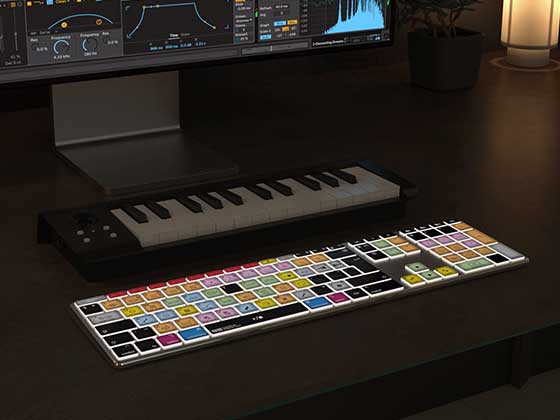
On the Editors Keys Logic Pro keyboard the legend colours match the modifier keys themselves. So you never have to remember which modifier a command needs — the colour tells you, and the modifier key at the bottom of the board is the same colour.
| Modifier | Legend colour |
|---|---|
| Command | Red |
| Option | Lilac |
| Shift | Blue |
| Control | Teal |
| The plain key, no modifier | White, centre of the key |
So Q shows white Quantize in the middle, red Quit above it and lilac Apply Quantize below. Three commands, one key, and you can tell at a glance which modifier each one needs.
Made by Editors Keys since 2005
The reference that never needs another window
Over 150 Logic Pro commands printed onto the keys, colour-coded to match the modifier keys themselves, with three levels of backlighting for late sessions. AB10 Air wireless or AB10 Core wired, built for Mac. Used by teams at the BBC, NASA, Warner Bros., Rockstar Games and Pinewood Studios.
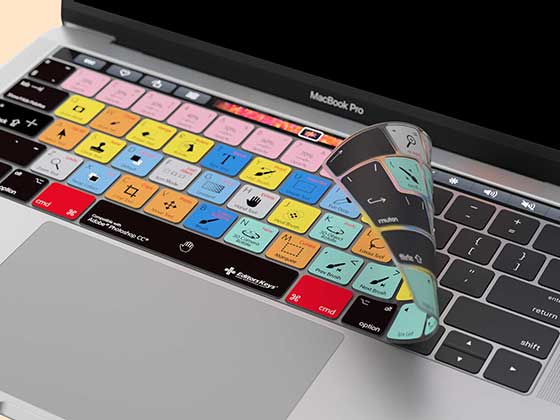
See the Logic Pro keyboard →On a MacBook? The silicone keyboard covers carry the same layout and protect the keys at the same time.
Screensets and windows
Plain numbers recall screensets — saved window arrangements. Command plus a number opens a specific window. Screensets are the most underused feature in Logic and the one most worth adopting.
| Action | Key |
|---|---|
| Recall screenset 1–9 | 1 – 9 |
| Open Main Window | Cmd + 1 |
| Open Mixer | Cmd + 2 |
| Open Piano Roll | Cmd + 4 |
| Open Score Editor | Cmd + 5 |
| Open Audio File Editor | Cmd + 6 |
| Open Event List | Cmd + 7 |
| Open Project Audio | Cmd + 8 |
Transport and playback
The numeric keypad carries a full transport, which is why a full-size keyboard beats a compact one for Logic.
| Action | Key |
|---|---|
| Play | Keypad Enter |
| Stop | Keypad 0 |
| Pause | Keypad . |
| Record | Keypad * |
| Play from selection | Shift + Space |
| Play from left window edge | Shift + Enter |
| Rewind / Forward | , . |
| Discard recording, return to last play position | Cmd + . |
| Go to end of last region | Opt + Return |
| Toggle Count-in | Shift + K |
Markers
The apostrophe key is the marker key, with modifiers for create, rename and delete.
| Action | Key |
|---|---|
| Create marker | Opt + ' |
| Create marker without rounding | Ctrl + Opt + ' |
| Create marker for selection | Opt + Shift + ' |
| Rename marker | Shift + ' |
| Delete marker | Opt + Delete |
| Go to previous marker, set locators | Opt + , |
| Go to next marker, set locators | Opt + . |
| Go to marker number | Opt + / |
| Recall markers 1–19 | Keypad 1 – 9 |
Cycle, locators and punch
U sets locators from whatever you have selected. Command-U does the same and turns Cycle on. Those two do most of the work.
| Action | Key |
|---|---|
| Set locators by selection | U |
| Set loop by selection, enable Cycle | Cmd + U |
| Forward by cycle length | Shift + Cmd + . |
| Rewind by cycle length | Shift + Cmd + , |
| Double cycle length | Opt + Shift + Cmd + . |
| Halve cycle length | Opt + Shift + Cmd + , |
| Set punch in locator by playhead | Ctrl + Opt + Cmd + I |
| Set punch out locator by playhead | Ctrl + Opt + Cmd + O |
| Toggle Autopunch mode | Ctrl + Opt + Cmd + P |
Windows and editors
| Action | Key |
|---|---|
| Show / hide Musical Typing | Cmd + K |
| Show / hide Step Input Keyboard | Opt + Cmd + K |
| Show / hide Event Float | Opt + E |
| Region Inspector Float | Opt + Shift + R |
| Open Tempo List | Opt + Shift + T |
| Open Key Command Assignments | Opt + K |
| Show / hide Colors | Opt + C |
| Show / hide Quick Help | Shift + / |
| Show Detailed Help | Cmd + / |
| Enter / exit full screen | Ctrl + Cmd + F |
| Open Movie | Opt + Cmd + O |
| Close window | Cmd + W |
| Minimise window | Cmd + M |
Project and file
| Action | Key |
|---|---|
| Save | Cmd + S |
| Save project as | Shift + Cmd + S |
| Open | Cmd + O |
| New empty project | Shift + Cmd + N |
| Close project | Opt + Cmd + W |
| Import | Cmd + I |
| Export track as audio file | Cmd + E |
| Export all tracks as audio files | Shift + Cmd + E |
| Export selection as MIDI file | Opt + Cmd + E |
| Project Settings | Opt + P |
| Settings | Cmd + , |
| Cmd + P | |
| Quit Logic Pro | Cmd + Q |
Mixing, channel strips and groups
| Action | Key |
|---|---|
| Solo tracks of selected regions | Ctrl + S |
| Mute off for all | Ctrl + Shift + M |
| Toggle channel strip input monitoring | Ctrl + I |
| Toggle channel strip format (mono / stereo) | Ctrl + Shift + S |
| Copy channel strip setting | Opt + Cmd + C |
| Paste channel strip setting | Opt + Cmd + V |
| Enable / disable groups | Shift + G |
| Show / hide Groups window | Opt + Shift + G |
| Create group for selected tracks | Ctrl + Cmd + G |
| Stop all cells (Live Loops) | Cmd + Return |
Automation
Logic's automation modes all sit on Control combinations, which keeps them out of the way of the editing keys.
| Action | Key |
|---|---|
| Open Automation Settings | Opt + A |
| Toggle selected tracks automation Off / Read | Ctrl + Cmd + O |
| Toggle selected tracks automation Latch / Read | Ctrl + Cmd + A |
| Set all tracks to automation Off | Ctrl + Shift + Cmd + O |
| Set all tracks to automation Read | Ctrl + Shift + Cmd + R |
| Set all tracks to automation Touch | Ctrl + Shift + Cmd + T |
| Set all tracks to automation Latch | Ctrl + Shift + Cmd + L |
| Toggle Automation Quick Access | Ctrl + Opt + Cmd + A |
| Track Automation Event List | Ctrl + Cmd + E |
| Plug-in undo / redo | Ctrl + Cmd + Z Ctrl + Shift + Cmd + Z |
Keys not doing what you expect?
Logic lets any command be reassigned, and a project or a preset carried over from another machine can bring a changed set with it. Open Key Command Assignments with Option-K and set the assignments back to the Logic Pro factory default. Everything on this page, and everything printed on a Logic Pro keyboard, assumes the factory set.
Frequently asked questions
Why does Logic Pro have so many keyboard shortcuts?
Because most of them aren't switched on. Logic's Key Commands window lists over 2,000 commands, but the large majority ship with no key assigned — they're there so you can assign them, not because they're active. The set that actually works out of the box is far smaller and completely learnable, and that's what this guide covers.
What are the single-key shortcuts in Logic Pro?
Logic assigns a large group of commands to single letters with no modifier: R record, C Cycle, K metronome, S solo, M mute, P Piano Roll, N Score Editor, X Mixer, Y Library, W Audio File Editor, V all plug-in windows, B Smart Controls. They open and close nearly every part of the application with one press, and they're the fastest speed gain available in Logic.
How do I switch between windows in Logic Pro?
Command plus a number. Command-1 Main Window, Command-2 Mixer, Command-4 Piano Roll, Command-5 Score Editor, Command-6 Audio File Editor, Command-7 Event List, Command-8 Project Audio. Pressing the numbers on their own recalls screensets instead — saved window arrangements you can switch between instantly.
What is a screenset in Logic Pro?
A saved arrangement of windows. Set the screen up how you want it for tracking, press Command and a number to store it, then press that number on its own to jump straight back to it. Most Logic users never use them, and they're one of the biggest workflow wins in the application.
Are Logic Pro shortcuts the same on Windows?
Logic Pro is Mac-only — Apple has never released a Windows version, so there's no Windows layout to convert. Every shortcut here uses Command, Option, Shift and Control as they appear on a Mac keyboard.
Which version of Logic Pro do these shortcuts apply to?
Logic Pro 12.3, the current release as of 2026. Logic's default assignments have been stable across recent versions, so these hold on Logic Pro 11 and most of 10 too.
Can I print the Logic Pro shortcuts?
Yes — the free PDF on this page is built for it. A4, grouped by task, and laid out to be read at arm's length rather than squinted at.
Related reading
- Pro Tools keyboard shortcuts: the complete 2026 cheat sheet
- DaVinci Resolve keyboard shortcuts: the complete 2026 cheat sheet
- Final Cut Pro keyboard shortcuts: the complete 2026 cheat sheet
- Avid Media Composer keyboard shortcuts: the complete 2026 cheat sheet
- The Editors Keys Logic Pro keyboard
Verified against Apple's official Logic Pro User Guide for Logic Pro 12.3, and cross-checked key by key against the mapping printed on the Editors Keys Logic Pro keyboard. Anything the two sources disagreed on was left out. Covers the default assigned key commands only. Logic Pro is a trademark of Apple Inc. Editors Keys is not affiliated with Apple Inc.