
Choosing a digital audio workstation is one of the biggest decisions a new producer, musician or audio engineer has to make. Your DAW becomes the central hub for recording, editing, arranging, mixing, sound design and, depending on your workflow, even live performance. Both Logic Pro and Ableton Live are powerful, mature platforms capable of producing professional results, but they approach music production in noticeably different ways.
For someone looking at Logic Pro vs Ableton Live in 2026, the choice is less about which DAW has the longest feature list and more about which environment suits the way you want to work. Logic Pro has a traditional studio-based approach with a particularly strong collection of instruments, effects and recording tools, while Ableton Live has a workflow built around flexibility, experimentation, clip-based production and live performance. Both can record vocals and instruments, programme MIDI, use software instruments, mix tracks, work with third-party plug-ins and produce commercially released music.
The good news is that neither choice locks you out of professional music production. Producers have made successful records with both platforms, and the fundamentals of recording, arranging, synthesis, sampling, mixing and mastering remain transferable between DAWs. The differences become much more important when you start considering how you actually want to make music.

Logic Pro vs Ableton Live at a glance
Logic Pro and Ableton Live share many of the same fundamental capabilities. Both provide multitrack audio recording, MIDI sequencing, software instruments, audio effects, automation, sample manipulation, mixing tools, virtual synthesisers, drum programming and support for third-party plug-ins. Both are capable of handling everything from a simple home recording to a large, complex production.
Where they differ is in how those capabilities are presented to the user. Logic Pro is built around the familiar concept of a timeline, tracks and regions, making it particularly approachable for musicians who think in terms of songs, arrangements and traditional recording sessions. Ableton Live offers that conventional Arrangement View too, but its Session View introduces a completely different way of working, allowing clips and musical ideas to be triggered, rearranged and experimented with without committing immediately to a linear arrangement.
| Feature | Logic Pro | Ableton Live |
|---|---|---|
| Traditional recording | Excellent | Excellent |
| MIDI production | Excellent | Excellent |
| Software instruments | Extensive built-in library | Extensive built-in library |
| Audio editing | Advanced | Advanced |
| Beat production | Excellent | Excellent |
| Electronic music | Excellent | Excellent |
| Live performance | Capable | Particularly strong |
| Clip-based workflow | Limited compared with Ableton | Core feature |
| Traditional timeline workflow | Excellent | Excellent |
| Built-in effects | Extensive | Extensive |
| Sampling | Powerful | Particularly flexible |
| Sound design | Extensive | Particularly strong |
| Learning curve | Relatively approachable | Can take longer initially |
| Mac integration | Excellent | Excellent |
| Windows support | No | Yes |
| iPad support | Yes | Yes, with Ableton Live's relevant iPad offering |
| Best suited to | Recording, songwriting, mixing and broad studio production | Electronic production, experimentation, performance and flexible workflows |
These are broad differences rather than hard rules. An electronic music producer can work brilliantly in Logic Pro, just as a singer-songwriter or recording engineer can produce an entire album in Ableton Live.
What is Logic Pro?
Logic Pro is Apple's professional digital audio workstation for Mac and iPad. It has evolved considerably from its early reputation as a recording and sequencing application and is now a comprehensive production environment covering recording, MIDI, synthesis, sampling, editing, mixing, mastering and sound design.
One of Logic Pro's biggest strengths is how much is included with the application. A new user can install Logic and immediately have access to a substantial collection of software instruments, drum sounds, loops, effects, samples and production tools without having to assemble a large collection of third-party plug-ins.

That makes Logic particularly attractive to beginners. You can learn synthesis using the included instruments, programme drums using Drum Machine Designer, record guitars and vocals through an audio interface, experiment with effects and build complete arrangements without needing to spend a fortune on additional software.
Logic also has a traditional studio layout that will be familiar to anyone who has used another timeline-based DAW. The main Tracks Area provides a conventional horizontal timeline, with audio and MIDI regions arranged across individual tracks. This makes it relatively easy to understand the relationship between recordings, instruments and the overall song structure.
What is Ableton Live?
Ableton Live takes a somewhat different approach. Although Ableton Live has a conventional Arrangement View that behaves much like the timeline in other DAWs, its defining feature is Session View.
Session View allows you to work with individual clips rather than immediately arranging everything along a fixed timeline. A clip might contain a drum loop, bass part, vocal phrase, synthesiser pattern or complete musical section. These clips can be triggered individually or together, allowing you to experiment with combinations before deciding how the finished arrangement should work.
This approach has become particularly influential in electronic music production because it encourages experimentation. Instead of deciding at the beginning that your song will have an eight-bar intro followed by a sixteen-bar verse and chorus, you can build up a collection of ideas and discover relationships between them.

Ableton Live is also closely associated with live electronic performance. Clips can be launched in real time, effects can be manipulated during a performance, instruments can be controlled with MIDI hardware and an entire set can be structured around Session View.
That does not mean Ableton is only for performing. Its Arrangement View is a fully capable production environment, and many producers use Ableton entirely within a conventional studio workflow.
Logic Pro and Ableton Live: what do they have in common?
Despite their different approaches, Logic Pro and Ableton Live have an enormous amount in common. If you understand one DAW, many of the concepts you learn will transfer directly to the other.
Both can record multiple microphones and instruments simultaneously, provided your computer and audio interface have the necessary inputs. You can create audio tracks for guitars, vocals, keyboards or external synthesisers, then edit the recordings, apply plug-ins, automate parameters and mix them alongside MIDI instruments.
Both also support MIDI sequencing. You can use a MIDI keyboard to play software instruments, draw notes into a piano roll, edit note velocity and timing, quantise performances and automate parameters. This makes either platform suitable for everything from realistic piano arrangements to complex electronic sequences.
Both DAWs also include extensive mixing environments. You can route tracks to buses, create auxiliary channels, add EQ and compression, automate volume and effects, create sends and returns, and build increasingly sophisticated signal chains.
Third-party plug-ins are another major area of overlap. Both platforms can be expanded with additional instruments and effects, although their specific plug-in formats and compatibility requirements differ.
For a beginner, this is important because learning the fundamentals of audio production is arguably more valuable than learning where a particular button is located. Understanding gain staging, EQ, compression, automation, arrangement, monitoring, synthesis and mixing will remain useful regardless of which DAW you eventually use.
Logic Pro: key features
A comprehensive collection of instruments and sounds
One of Logic Pro's strongest advantages is the amount of content available within the application. Apple's software instruments cover synthesis, sampled instruments, drums, pianos, orchestral sounds, vintage keyboards and many other production requirements.
For someone starting from scratch, this can be extremely useful. You can spend your first few months learning production rather than constantly searching for another plug-in to fill a particular gap.
Logic's library also makes it straightforward to audition sounds while writing. You can browse patches, loops and instruments directly within the DAW and quickly test different sounds against your existing arrangement.
Recording and audio editing
Logic Pro is well suited to traditional recording. If you are recording a band, singer-songwriter, guitarist, vocalist or instrumental project, the Tracks Area provides an intuitive environment for organising takes and editing recordings.
Logic also includes tools for comping performances, editing timing and pitch, managing takes and working with multiple recorded versions. This makes it suitable for professional studio work as well as home recording.
For musicians who want to record real instruments alongside programmed parts, Logic provides a particularly complete environment.
Logic's MIDI and piano roll
MIDI editing is another area where Logic has developed into a very capable production environment. The Piano Roll allows you to draw and manipulate notes, alter velocities, adjust timing and create detailed musical patterns.
You can use MIDI to control software synthesisers, samplers and virtual instruments, or record performances from a MIDI keyboard and then refine them afterwards.
For producers who enjoy writing melodies, chord progressions and arrangements directly on the computer, Logic provides a familiar and relatively straightforward environment.
Logic Pro's Drummer
Logic's Drummer system is particularly useful for producers who want convincing drum performances without manually programming every hit. You can choose different drummer styles and adjust the performance to suit your arrangement.
It is also useful as a songwriting tool. You can establish a rough guitar or piano progression, add a drummer and quickly create a rhythm section around the idea.
For beginners, this can make the process of turning a musical idea into a complete arrangement considerably less intimidating.

Flex Time and Flex Pitch
Logic also provides dedicated tools for manipulating recorded audio. Flex Time can be used to adjust the timing of performances, while Flex Pitch provides pitch editing capabilities.
These tools are useful when recording real musicians because they allow you to make corrections without necessarily having to rerecord an entire performance.
They also become useful creative tools. Time and pitch manipulation can be pushed beyond simple correction to create deliberately unusual sounds and arrangements.
Logic's mixing environment
Logic has a traditional mixer that will be familiar to anyone who has worked in a recording studio. Channel strips provide access to inserts, sends, faders, pan controls and routing, allowing you to build complex mixes.
The built-in effects cover many of the fundamentals required for mixing, including EQ, compression, reverb, delay, modulation and distortion.
For a beginner, having these tools included from the beginning is valuable because you can learn what a compressor or EQ actually does before worrying about which expensive third-party alternative you should buy.

Ableton Live: key features
Session View
Session View is probably the biggest reason someone chooses Ableton Live instead of another DAW.
Rather than forcing you to construct a song from left to right immediately, Session View lets you organise musical ideas into clips and scenes. You can experiment with combinations of drums, bass, vocals, synthesisers and samples, then record your performance into Arrangement View.
This is particularly powerful for electronic music, improvisation and experimental production. It can also be useful for musicians who struggle with the feeling that they need to decide on the final arrangement too early.
Arrangement View
Ableton's Arrangement View provides the conventional timeline workflow you would expect from a modern DAW. Tracks run vertically while time moves horizontally, allowing you to construct a finished song from beginning to end.
This means Ableton can comfortably handle traditional songwriting and recording as well as its more experimental Session View workflow.
You can record audio, programme MIDI, automate parameters, edit clips and build complete arrangements within the same project.
Warping and time manipulation
Audio warping is another important part of Ableton's identity. Warping allows audio material to be manipulated in relation to the project tempo.
This is particularly useful when working with samples, loops and recordings that were not originally created at the same tempo as your project. You can experiment with timing and arrangement without necessarily having to render new versions of every piece of audio.
For electronic producers and sample-based musicians, this can become a fundamental part of the creative process.

Sampling
Ableton Live has a particularly strong reputation among sample-based producers. Audio can be chopped, warped, reversed, repitched and rearranged in numerous ways.
This makes it possible to take a recording that was never intended to function as a conventional musical instrument and turn it into something completely different.
That could mean slicing a drum break into individual hits, turning a vocal recording into a playable instrument or transforming an environmental recording into a rhythmic texture.
Max for Live
Max for Live adds another layer of flexibility to Ableton Live by allowing users to work with devices created using Max. Depending on the Live edition and current feature set, this can provide additional instruments, effects, utilities and experimental tools.
For technically minded producers, Max for Live can be particularly interesting because it opens the door to highly specialised devices and unusual workflows. It is not something a beginner needs to understand immediately, but it is one of the features that can make Ableton increasingly interesting as your knowledge develops.

Which DAW is easier for beginners?
This is one of the more difficult questions to answer because the easiest DAW depends heavily on what you already understand.
For someone coming from a traditional recording background, Logic Pro may feel immediately familiar. Its main workspace resembles the conventional studio timeline used by many other DAWs, and the organisation of tracks, regions, mixer channels and plug-ins is relatively straightforward.
Logic also benefits from the fact that much of its content is immediately available. A beginner can open a software instrument, select a patch, connect a MIDI keyboard and start making music without needing to understand a large number of additional systems.
Ableton Live can initially feel less conventional. Session View can be confusing if you have only ever worked with linear timelines, because clips and scenes introduce a different way of thinking about arrangements.
Once the concept clicks, however, Session View can become extremely intuitive. The ability to launch clips and experiment with combinations means you can build music in a very immediate way.
The important distinction is therefore between traditional familiarity and creative flexibility. Logic may make more immediate sense to someone accustomed to a recording studio, whereas Ableton's workflow can become extremely fast once you understand its underlying concepts.
Logic Pro vs Ableton Live for electronic music
Both DAWs are highly capable electronic music production platforms, so choosing between them comes down to workflow rather than whether one is capable of producing electronic music.
Logic provides an enormous collection of synthesisers, samples, drum tools and effects, making it possible to create sophisticated electronic productions entirely within the application.
Ableton Live, meanwhile, is deeply integrated around clip launching, sampling, warping and experimentation. If your production process involves constantly manipulating loops, resampling sounds, improvising arrangements or performing electronic music live, Ableton's design can fit that workflow particularly naturally.
Techno, house, ambient, experimental electronic music, drum and bass and countless other genres can be produced effectively in either.

Logic Pro vs Ableton Live for recording vocals and instruments
If your main priority is recording a band, singer, guitarist, pianist or other live musicians, Logic's traditional studio workflow may be particularly appealing.
Logic makes it easy to create multiple audio tracks, organise takes, edit performances and construct a conventional song arrangement. Its collection of recording and mixing tools also means that you can build a substantial project without immediately relying on third-party software.
Ableton is also fully capable of professional recording. You can record multiple inputs, edit audio and build conventional arrangements in Arrangement View. However, someone whose primary interest is traditional multitrack recording may find Logic's overall environment more naturally aligned with that workflow.
Logic Pro vs Ableton Live for songwriting
Logic is particularly strong if you tend to think about songwriting in terms of verses, choruses, bridges, instrumental sections and a linear timeline.
You can start with a guitar recording, add a bass part, programme drums, record vocals and gradually build the arrangement. Logic's extensive instrument library also gives songwriters plenty of sounds to experiment with.
Ableton can encourage a different style of songwriting. You might create a drum loop, bass idea and synth pattern independently, place them into clips and experiment with combinations before deciding which ideas belong in the final song.
Neither approach is inherently better. The more important question is whether you prefer to construct a song from the beginning or collect and experiment with ideas before arranging them.

Logic Pro vs Ableton Live for live performance
This is an area where Ableton Live has a particularly strong identity.
Session View was designed around the idea that clips can be triggered and manipulated during performance. A producer can build an entire live set from scenes and clips, connect MIDI controllers and manipulate effects while performing.
Logic can certainly be used in live situations, and Apple's MainStage ecosystem is also relevant to musicians who want to use Apple's software and instruments on stage. However, Ableton Live's clip-based performance workflow is much more central to the DAW itself.
If live electronic performance is one of your primary goals, Ableton is therefore worth investigating closely.
Logic Pro vs Ableton Live for mixing
Both applications provide the essential tools required for professional mixing. You can EQ individual tracks, compress dynamics, automate volume, create buses, use sends and returns, apply reverb and delay, pan instruments and build complex signal chains.
Logic's mixer will feel particularly familiar to engineers coming from traditional studio environments. Tracks and channel strips have a conventional relationship, and the interface encourages you to think about the mix as a collection of channels being balanced together.
Ableton's mixer is also highly capable, although its visual presentation and workflow are different. Once you understand routing, returns, groups and device chains, it becomes a powerful mixing environment.
Ultimately, mixing skill is much more important than the choice between these two DAWs. A well-balanced mix does not depend on whether the project was created in Logic or Ableton.
Logic Pro vs Ableton Live for sound design
Both DAWs can become extremely deep sound-design environments.
Logic provides a broad collection of synthesisers and effects, allowing you to build patches from scratch or manipulate existing sounds. Its instruments cover subtractive synthesis, wavetable-style approaches, sampling and other techniques.
Ableton also provides an extensive collection of instruments and effects, while its routing, modulation, sampling and Max for Live ecosystem can make it particularly attractive to producers who enjoy creating unusual instruments and effects chains.
If sound design is your main interest, it is worth trying both rather than choosing based solely on specifications. The way an instrument's interface encourages you to experiment can have a major effect on how you work.
The biggest disadvantage of Logic Pro
The most obvious limitation of Logic Pro is platform compatibility. Logic is designed for Apple's ecosystem, so it is not a Windows DAW.
That is an important consideration before you invest heavily in a Logic-based workflow. If you regularly switch between Mac and Windows computers, Ableton Live may provide more flexibility.
Logic can also feel less immediately suited to clip-based experimentation than Ableton. While Logic has developed increasingly flexible approaches to loops and live performance, Session View remains one of Ableton's defining characteristics.
The biggest disadvantage of Ableton Live
Ableton's flexibility can also make it more intimidating when you first open it.
A beginner may encounter Session View, Arrangement View, racks, clips, scenes, devices, returns and routing concepts without immediately understanding how they fit together.
This is not necessarily a weakness once you become familiar with the software, but it can make the first few sessions feel less straightforward than a conventional timeline-based DAW.
Ableton's enormous flexibility can also encourage experimentation at the expense of finishing tracks. Having hundreds of ways to manipulate a loop is exciting, but it can also make it easy to spend hours tweaking sounds without actually completing the arrangement.

Logic Pro vs Ableton Live: which should you choose?
If you are choosing between Logic Pro and Ableton Live, start with the type of music you want to make and how you naturally approach production.
Logic Pro may suit you particularly well if you:
You primarily use a Mac and want a comprehensive studio environment with recording, MIDI, instruments, effects and mixing tools built into one application. Logic is also worth considering if you record vocals or instruments regularly, prefer a traditional timeline and want a large collection of included sounds and instruments.
Ableton Live may suit you particularly well if you:
You are interested in electronic music, sampling, sound design, clip-based production, improvisation or live performance. Ableton is also worth considering if the idea of creating lots of musical ideas independently and arranging them later appeals to you.
Either DAW can work well if you:
Want to record, produce, arrange and mix your own music, use MIDI instruments, work with samples, install third-party plug-ins and develop professional production skills.
The most useful thing you can do before committing is to spend time actually using both interfaces. A feature comparison can tell you what each DAW contains, but it cannot tell you which workflow feels natural when you are sitting in front of it trying to write a song.
Don't overlook keyboard shortcuts
Whichever DAW you choose, learning keyboard shortcuts can make a surprisingly large difference to how quickly you can work.
Music production involves an enormous number of repetitive operations. Creating tracks, moving between tools, cutting regions, splitting clips, zooming, opening editors, navigating the timeline, quantising MIDI, duplicating sections and controlling playback can all require repeated interaction with menus and the mouse.
Learning the relevant keyboard shortcuts allows many of these operations to become almost automatic. Instead of stopping what you are doing to find a particular function with the mouse, you can trigger it from the keyboard and keep your attention on the music.
This is particularly valuable as your projects become larger. The difference between reaching for a menu several hundred times during a project and using a shortcut without thinking can add up to a significant amount of time.
Editors Keys shortcut keyboards for Logic Pro and Ableton Live
This is where an Editors Keys shortcut editing keyboard can become a useful addition to your studio.
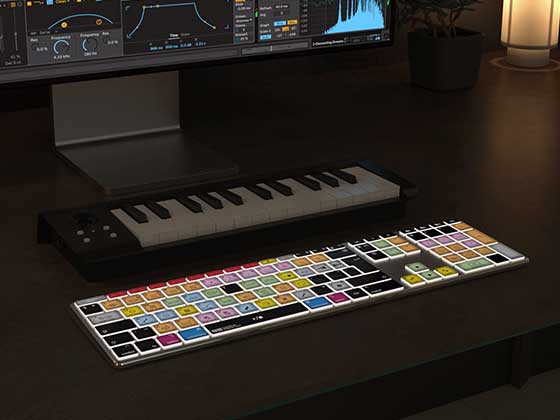
Editors Keys keyboards are designed with commonly used software shortcuts mapped directly onto the keys, allowing you to see the commands you need while you work. Rather than constantly referring to a shortcut list or searching through menus, the relevant commands are printed directly onto the keyboard.
This can also help with memorisation. When you repeatedly see and use a shortcut during your normal production workflow, you can gradually learn the command through repetition rather than having to memorise an enormous list of shortcuts before you begin.

For Logic Pro and Ableton Live users, that can make the keyboard particularly useful during the learning stage. You can look down at the relevant key, use the shortcut and eventually reach the point where the command becomes second nature.
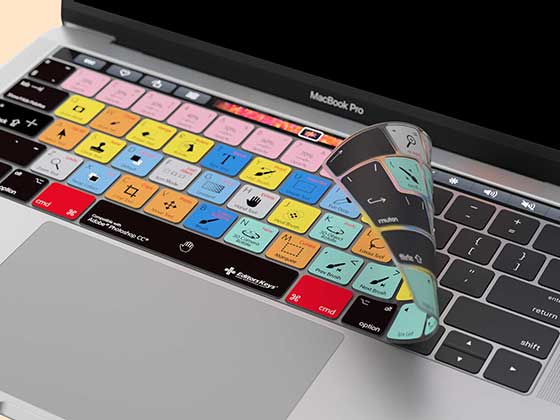
Editors Keys also produces silicone shortcut keyboard covers, providing another way to keep your most-used commands visible while working. The covers are designed around specific software workflows, so you can see the relevant shortcuts directly over your existing keyboard.
For producers who already have a keyboard they like, a silicone shortcut cover can therefore be a straightforward way to add a visual shortcut reference without replacing the entire keyboard.
AB10 Air and AB10 Core shortcut keyboards
The Editors Keys AB10 Air Wireless Backlit Shortcut Keyboard and AB10 Core Wired USB-C Backlit Shortcut Keyboard are designed for producers and editors who want shortcuts directly on the keyboard while working.
Both provide a backlit keyboard layout, making the shortcut information easier to see when working in a darker studio environment. The AB10 Air provides a wireless workflow, while the AB10 Core uses a wired USB-C connection.
Having shortcuts physically printed onto the keys is particularly useful when learning a new DAW. Rather than keeping a shortcut cheat sheet open on a second monitor, searching online or repeatedly opening menus, you can use the keyboard itself as a constant reference.
That can be particularly helpful when moving from one DAW to another. If you have spent years using one program and decide to learn Ableton Live or Logic Pro, the different keyboard commands can initially feel unfamiliar. A shortcut keyboard can reduce that friction by putting the relevant commands directly in front of you.
For experienced producers, the benefit is slightly different. Once you already know many of the shortcuts, the keyboard can help keep frequently used commands immediately accessible and reduce reliance on the mouse.
Are shortcut keyboards worth it for beginners?
A shortcut keyboard will not teach you how to mix a record or write a great melody, but it can remove one of the smaller barriers between knowing what you want to do and actually doing it.
Beginners often spend a lot of time navigating menus because they have not yet memorised the keyboard commands. This is completely normal. The problem is that repeatedly stopping to search for functions can interrupt the creative process.
Having the commands printed directly onto the keyboard gives you a visual reference while you learn. Over time, you may find that you stop consciously reading the labels because your hands have memorised the commands through repetition.
The same principle applies to experienced users learning a new application. If you already know another DAW, you have probably developed muscle memory for a large number of commands. A shortcut keyboard can make the transition to a different DAW less frustrating by giving you a visual reminder of the new shortcuts.

Logic Pro vs Ableton Live: the final decision
There is no universal answer to the question of whether Logic Pro or Ableton Live is the better DAW. Both are professional production platforms with enough depth to support years of learning and experimentation.
Logic Pro offers a comprehensive studio environment that is particularly appealing to Mac users who want recording, songwriting, MIDI, virtual instruments, audio editing and mixing within a familiar timeline-based interface. Its extensive included sound library also makes it an attractive option for beginners who want to start producing without immediately buying a large collection of additional plug-ins.
Ableton Live takes a more experimental approach, with Session View providing a distinctive way to create, manipulate and perform music. Its strengths in clip launching, sampling, warping, sound design and live performance make it particularly interesting for electronic producers and musicians who want a more flexible approach to arranging ideas.
For traditional recording and songwriting, Logic's workflow may feel more immediately familiar. For clip-based production, experimentation and live electronic performance, Ableton's design may align more closely with the way you want to work. But both DAWs are capable of crossing these boundaries, and neither choice prevents you from developing the core production skills that matter most.
Whichever DAW you choose, learning its keyboard shortcuts should be part of the process. The faster you can navigate your software, edit recordings and manipulate your arrangement, the more time you can spend concentrating on the music itself. An Editors Keys shortcut keyboard or silicone shortcut cover can keep those commands visible while you learn, helping turn unfamiliar shortcuts into familiar muscle memory.
For producers building a new studio in 2026, the most important decision is therefore not simply Logic Pro vs Ableton Live. It is finding a production environment that encourages you to create, learn and finish music consistently. Once you have that foundation, the software becomes a tool rather than a barrier between the idea in your head and the finished recording.