
If you are building a music production setup in 2026, you do not need to spend hundreds of pounds on plugins to get professional results. The free VST plugin scene has become remarkably good, with modern instruments and effects offering the kind of synthesis, mixing, sound-design and spatial processing that would once have required a sizeable plugin budget.
Whether you produce in Logic Pro, Ableton Live, Cubase, Pro Tools, FL Studio, Studio One or another modern DAW, adding a few carefully chosen free plugins can dramatically expand what you can do inside your sessions. The important thing, however, is not to download every free plugin you come across. A smaller collection of genuinely useful tools is usually far more valuable than a plugin folder containing hundreds of instruments and effects that you never use.
For this guide, we have selected five free plugins that cover very different areas of music production: synthesis, reverb and delay, dynamic EQ, compression and sampled instruments. These are not deliberately obscure freeware plugins chosen simply because they are free; they are established tools that can genuinely earn a place in a serious production workflow.

1. Vital – The Best Free Wavetable Synthesiser
If you only download one free synthesiser in 2026, Vital is an extremely strong candidate. Developed by Vital Audio, Vital is a spectral-warping wavetable synthesiser that offers an extraordinarily deep sound engine without putting the core synthesiser behind a paid upgrade. The developer currently offers a Basic version of Vital for free, including the complete synth engine, with paid tiers primarily providing additional presets and wavetables.
That distinction is important. Some "free" synthesiser plugins are effectively demonstrations of a paid product, limiting the number of oscillators, filters, effects or other fundamental features. Vital is different: the free version gives you the actual synthesiser and its core capabilities. The main limitation is the amount of factory content supplied with the free tier, rather than the underlying synthesis engine.
What is Vital?
Vital is a wavetable synthesiser, meaning that its oscillators generate sound from tables containing waveforms rather than being restricted to the traditional sine, triangle, saw and square waves found on classic analogue-style synthesisers.
The real strength of wavetable synthesis is that the oscillator can move through different waveform shapes. Instead of playing one static waveform, you can automate or modulate the position within the wavetable, causing the harmonic content of the sound to change over time.
Vital takes this considerably further with its spectral warping system. You can stretch, shift, smear and otherwise manipulate the harmonic structure of a wavetable, creating sounds that can move from relatively conventional synth tones into completely digital, metallic, aggressive or experimental territory. Vital describes this as spectral warping, and it is one of the features that makes the instrument particularly powerful for modern sound design.
What can you make with Vital?
The obvious applications include bass, leads, pads, plucks, arpeggios and electronic percussion, but Vital is capable of considerably more. Its modulation system makes it particularly good for creating sounds that evolve throughout a note rather than simply producing a static timbre.
For example, you could start with a relatively simple saw-based wavetable, use an envelope to control the filter cutoff and then assign an LFO to the wavetable position. Add some subtle pitch modulation, introduce stereo movement and finish the sound with Vital's built-in effects, and you can have a complex evolving patch without adding another plugin to the track.
Vital also includes a built-in wavetable editor, allowing you to create your own wavetables. The current version can also turn samples into wavetables using its pitch-splice and vocode conversion tools, while its text-to-wavetable functionality provides another unusual way of generating source material.
That makes Vital useful not only as a preset player but as a genuine sound-design instrument.

Vital's modulation system
One of the best aspects of Vital is its visual approach to modulation. Rather than opening a series of complicated routing menus, you can drag a modulation source onto a parameter and then adjust the amount of modulation directly.
This makes it particularly useful for people learning synthesis because you can actually see what is happening. Assign an LFO to the filter cutoff and you can watch the modulation move. Assign an envelope to wavetable position and you can immediately understand how the sound is changing.
Vital supports audio-rate modulation, keytracked LFOs, MPE, microtuning and stereo modulation, giving it considerably more depth than its "free synth" label might suggest. The developer also states that its oscillators are designed for a low noise floor and minimal aliasing, while its modulation system is optimised for efficient operation.
Vital compatibility in 2026
Vital supports VST, VST3, AU and LV2 and runs on Windows 10 or later, macOS 10.15 or later and supported Linux systems. The current Vital website also explicitly supports both Intel and Apple Silicon Macs.
That makes it particularly versatile if you move between Ableton Live, Cubase, Logic Pro and other DAWs.
Remember that Logic Pro does not use VST/VST3 plugins in the normal way. On Mac, you should install the AU version when using Vital in Logic Pro.
How to download Vital
The safest way to download Vital is through the official Vital Audio website, rather than using third-party plugin download sites. Choose the free Basic version and install the appropriate plugin formats for your computer and DAW.
Download Vital from the official Vital Audio website
Once installed, rescan your plugins if necessary and load Vital onto an instrument track. In Logic Pro, look under Audio Units; in Ableton Live and Cubase, use the VST3 version; and in other compatible DAWs, select the format appropriate to your system.
Why Vital deserves a place in your plugin folder
Vital is more than a free alternative to a commercial synthesiser. It is a genuinely powerful instrument that can be used from the earliest stages of songwriting through to detailed sound design.
If you produce electronic music, ambient music, hip-hop, synthwave, techno, house, pop, experimental music or film music, Vital can provide an enormous range of sounds without costing you anything.

2. Valhalla Supermassive – The Best Free Reverb and Delay Plugin
Some plugins are useful. Others become permanent fixtures in almost every producer's template. Valhalla Supermassive falls firmly into the second category.
Developed by Valhalla DSP, Supermassive is a free reverb and delay effect designed around enormous spaces, long echoes, modulation and atmospheric effects. It can produce conventional ambience, but its real strength is creating the sort of gigantic, unstable and evolving spaces that are difficult to achieve with a standard algorithmic reverb.
Valhalla continues to develop Supermassive despite giving it away for free, with major updates having introduced additional modes over its lifetime. The current official Supermassive page lists compatibility with 64-bit VST2.4, VST3 and AAX on Windows, plus VST2.4, VST3, AAX and AU on Mac. It supports Intel and Apple Silicon Macs, including current generations of Apple hardware.
What does Valhalla Supermassive do?
At its simplest, Supermassive creates delay and reverb effects. Turn the Mix control up, increase the delay and feedback and you can transform a dry sound into a huge atmospheric wash.
However, Supermassive is not simply a conventional room reverb with a very long decay time. Its architecture is based around delay networks that can create enormous, evolving echoes and reverberant textures.
This makes it particularly useful for sounds that need to occupy a large amount of space. A vocal can become surrounded by an ethereal tail, a guitar can be transformed into an ambient texture, a synth pad can become almost infinite, and a simple drum hit can turn into a strange rhythmic soundscape.

The modes are where Supermassive becomes really interesting
Supermassive includes a range of different modes, each with a different character. Some produce relatively clean and spacious delays, while others create much denser and more diffuse reverberation.
The developer has added modes through multiple major updates, including Orion, Cassiopeia, Cirrus Major, Cirrus Minor, Aquarius, Pisces, Scorpio, Libra, Leo, Virgo, Pleiades and Sirius.
The modes mean that Supermassive can cover a surprising amount of ground. You can use a relatively restrained setting to add depth to a vocal, or push the feedback and density until a single note develops into a constantly evolving wall of sound.
How producers can use Supermassive
One of the best ways to use Supermassive is on an auxiliary/send track. Instead of inserting it directly onto every track, create a send, load Supermassive and send selected amounts of vocals, guitars, synths or percussion into it.
This gives you much more control over the relationship between the dry and wet signal. You can keep a vocal relatively clear while sending enough of it into Supermassive to create an atmospheric tail behind the performance.
It is also fantastic for sound design. Try putting Supermassive on a guitar feedback recording, an individual synth note or even a short vocal sample, then automate the Mix, Feedback, Warp or other parameters. A tiny piece of audio can become an entirely new texture.
The plugin can also be used for ambient music, cinematic sound design, psychedelic production, post-rock, electronic music, experimental music and vocal effects.
Supermassive is particularly good for automation
One of the most creative things you can do with Supermassive is automate it.
Instead of leaving the same reverb setting running for an entire song, automate the effect so that it becomes enormous at the end of a vocal phrase, explodes during a transition or suddenly opens up during a chorus.
For example, you could have a vocal relatively dry during a verse, then automate the send level upwards on the final word of a line. Supermassive catches the word and throws it into a huge reverberant space, allowing the effect to disappear naturally before the next section.
That is a much more musical use of a reverb than simply putting it on a track and forgetting about it.

How to download Valhalla Supermassive
Supermassive is available directly from Valhalla DSP and is free. Avoid unofficial download sites and use the developer's own download page so that you are getting the current legitimate build.
Download Valhalla Supermassive from Valhalla DSP
It is available in the major plugin formats needed for modern Windows and Mac DAWs, including VST3, AU and AAX, making it suitable for Ableton Live, Cubase, Logic Pro and Pro Tools.
Why Supermassive is one of the best free VST effects in 2026
There are countless free reverbs available, but Supermassive is different because it has a distinctive identity. It does something that many stock reverbs cannot do particularly easily: it turns ordinary sounds into enormous musical textures.
For a free plugin, that is an exceptional amount of creative potential.
3. TDR Nova – The Best Free Dynamic EQ
If Vital is about creating sounds and Supermassive is about transforming them, TDR Nova is about controlling them.
Developed by Tokyo Dawn Records, TDR Nova is a dynamic equaliser that can operate as a conventional parametric EQ but can also react dynamically to the audio passing through it. That makes it one of the most useful free mixing plugins available.
The current official free version is TDR Nova 2.2.2, with Tokyo Dawn's latest maintenance information listing fixes and improvements including output parameter smoothing, display fixes and other usability improvements. The plugin is available for Windows and Mac and supports VST2, VST3, AU and AAX in 64-bit configurations.
What makes a dynamic EQ different?
A normal EQ applies a fixed change to the frequency spectrum. If you cut 3 dB at 3 kHz, that cut remains active regardless of what the instrument is playing.
Dynamic EQ adds another dimension: the EQ can respond to the level of a particular frequency range.
Imagine a vocal where the singer sounds perfectly balanced most of the time, but certain words suddenly become harsh around 4 kHz. A conventional EQ would force you to choose between leaving the harshness alone or cutting that frequency throughout the entire performance.
With dynamic EQ, you can configure a band around the problematic frequency and make it reduce that area only when the level becomes excessive. That is an extremely powerful technique for modern mixing.

Using TDR Nova on vocals
Vocals are one of the best applications for Nova.
Start by identifying a problematic frequency. This might be a harsh upper-midrange area, excessive low-mid build-up or a resonant frequency that only appears on particular notes.
Create a band around that frequency and enable its dynamics section. Rather than permanently removing the frequency, Nova can now reduce it when it crosses the threshold.
The result can sound considerably more natural than a heavy static EQ cut because you are allowing the vocal to retain its character when the problem is not present.
TDR Nova for guitars and synths
Nova is equally useful on guitars. Electric guitar recordings can contain resonances that become particularly aggressive when certain chords or notes are played. Instead of cutting the offending frequency across the entire performance, dynamic EQ lets you tame the resonance only when it becomes problematic.
The same technique works brilliantly on synthesiser patches. A synth bass might sound balanced on most notes but become excessively boomy on particular pitches. A dynamic low-frequency band can reduce that excess only when necessary.
This is especially useful when you have a sound that you like, but which occasionally gets out of control.
TDR Nova as a normal EQ
You should not think of Nova solely as a dynamic EQ. It can also function as a conventional parametric EQ, meaning you can use it for high-pass filtering, low-pass filtering, tonal shaping and corrective EQ.
That makes it an extremely efficient plugin to have in your collection because a single free plugin can cover both ordinary EQ work and more advanced dynamic processing.
Tokyo Dawn describes Nova as a dynamic equaliser in parallel configuration, combining precise tone control with dynamics processing.
TDR Nova and mastering
Nova can also be useful on buses and mastering chains, although restraint is important.
A dynamic EQ can be extremely effective for controlling a small problem in a finished mix. For example, if the upper-midrange becomes overly aggressive only when a dense chorus arrives, a gentle dynamic band can prevent the mix from becoming harsh without dulling the entire song.
This is one of the fundamental advantages of dynamic processing: you can solve problems without permanently changing the sound.

How to download TDR Nova
Tokyo Dawn Records provides the current free version directly from its website. The company offers both a download through its TDR Collector library manager and direct installers for Windows and macOS.
Download TDR Nova from Tokyo Dawn Records
For Logic Pro, install the AU version. For Ableton Live, Cubase and other VST3-compatible DAWs, install VST3. Pro Tools users should install the AAX version. Tokyo Dawn specifically lists native Apple Silicon support and AAX Apple Silicon support in the plugin's update history.
Why TDR Nova is worth downloading
Every producer eventually encounters a frequency that is fine most of the time but problematic at certain moments. TDR Nova gives you a sophisticated way of dealing with exactly that situation.
It is also an excellent plugin for learning advanced mixing because it demonstrates the difference between static EQ and dynamic EQ without requiring you to spend money on an expensive mastering suite.
4. TDR Kotelnikov – The Best Free Compressor
Compression is one of the most important processes in music production, but it can also be one of the most misunderstood. A compressor can control peaks, change the apparent dynamics of a performance, increase consistency and help different elements sit together, but aggressive compression can also make a recording lifeless.
This is where TDR Kotelnikov comes in.
Kotelnikov is a high-quality dynamics processor from Tokyo Dawn Records designed particularly around transparent wideband compression. The free version provides a serious compressor rather than a deliberately simplified "lite" effect, making it an excellent option for producers who want to learn compression without buying an expensive mastering plugin.
Tokyo Dawn describes Kotelnikov as a state-of-the-art wideband dynamic range controller suitable for stereo bus compression and critical applications.

What is Kotelnikov good at?
Kotelnikov is particularly useful when you want to control dynamics without obviously changing the character of the sound.
That makes it excellent for mix buses, acoustic instruments, vocals, drum buses and mastering-oriented applications.
A classic use is gentle mix-bus compression. Instead of trying to squash the entire mix, you can use a relatively low amount of gain reduction to make the elements feel slightly more cohesive.
The important thing is to listen to the relationship between the compressed and uncompressed signal rather than simply watching the gain-reduction meter.
Compression is about movement, not simply loudness
One of the most common mistakes when learning compression is to judge the effect by whether the processed signal sounds louder.
If compression reduces the peaks and you then compensate with output gain, the compressed version can easily sound "better" simply because it is louder. This can lead to applying far more compression than the music actually needs.
Kotelnikov is an excellent plugin for learning to avoid this trap because it can be used for very subtle processing.
Try placing it on a stereo mix and starting with only a small amount of gain reduction. Adjust the attack and release so that the compressor moves naturally with the music. Then match the output level to the bypassed signal and listen to what the compressor is actually doing.
Kotelnikov on drums
Drum buses are another excellent application.
You can use compression to make a collection of individual drum tracks feel more like a single instrument. A carefully chosen attack can allow some of the initial transient through while the compressor controls the body of the drum sound.
The release then determines how quickly the compressor recovers. Set it too fast and you can create audible pumping; set it too slowly and the compressor may still be working when the next important transient arrives.
There is no universal setting because the correct attack and release depend on the tempo, performance and musical style of the track.
Kotelnikov on vocals
Kotelnikov can also provide gentle control over vocal dynamics. If a singer moves significantly closer and further away from the microphone, or simply has a very dynamic performance, compression can help maintain a more consistent level.
It is often better to combine compression with clip gain or volume automation rather than expecting the compressor to fix every problem. Compression should be part of the solution, not an excuse to ignore the underlying dynamics of a recording.

How to download TDR Kotelnikov
Kotelnikov is available from Tokyo Dawn Records, with the free version offered directly from the developer.
Download TDR Kotelnikov from Tokyo Dawn Records
The current plugin supports VST2, VST3, AU and AAX in its 64-bit builds, making it suitable for a wide range of Windows and Mac DAWs, including Logic Pro, Ableton Live, Cubase and Pro Tools.
Why Kotelnikov makes this list
There are thousands of free compressors, but Kotelnikov stands out because it is genuinely useful for serious mixing. It is not simply a novelty compressor designed to make everything sound obviously squashed.
If you are learning how compression works, Kotelnikov is particularly valuable because it allows you to explore subtle dynamics processing and understand what attack, release, threshold and gain reduction are actually doing to your music.
5. Spitfire Audio LABS and Splice INSTRUMENT – Free Sampled Instruments
For the fifth and final entry, we are including something slightly different because no free music production collection is complete without access to high-quality sampled instruments.
Spitfire Audio LABS has been one of the most popular sources of free sampled instruments for years, providing producers with beautifully recorded pianos, strings, experimental instruments, textures and other sounds. However, there is an important change that producers need to know about in 2026: LABS has been moved into Splice INSTRUMENT.
Spitfire Audio confirmed in July 2026 that LABS is not disappearing, but that its content is now part of Splice INSTRUMENT. The company says that LABS content is available under the LABS and Spitfire labels within INSTRUMENT, while the original LABS plugin continues to receive maintenance for existing projects. New content is being delivered through INSTRUMENT, with free drops available for users.
This is an important distinction if you are searching for "free LABS VST" in 2026. You may still find older download guides referring to the standalone LABS plugin, but the current ecosystem has changed.

What is Splice INSTRUMENT?
Splice INSTRUMENT is a free sample-based virtual instrument that can run as a plugin or standalone application. Spitfire Audio states that it is available as VST3, AU and AAX, meaning it can be loaded directly into major DAWs including Ableton Live, Logic Pro, Cubase and Pro Tools.
This is particularly useful because it means one instrument platform can serve multiple DAWs.
Logic Pro users can load the AU version, Ableton Live and Cubase users can use VST3, and Pro Tools users can use AAX.
What can you find inside LABS?
The appeal of LABS has always been the variety of sounds. Instead of giving you another conventional synthesiser, it gives you access to sampled performances and unusual instruments that can immediately add character to a production.
A beautifully recorded felt piano can provide the foundation for a song. A string instrument can add movement to a chorus. An experimental texture can become the foundation of an ambient track. A prepared piano, plucked instrument or unusual percussion sound can give a production something that a conventional synthesiser cannot easily recreate.
This is particularly valuable for producers who work primarily with electronic instruments but want to introduce organic texture into their arrangements.
Why sampled instruments are so useful
A major advantage of sampled instruments is that you are starting with a real performance or recording rather than synthesising every aspect of the sound yourself.
That can make a huge difference when you are trying to write quickly.
Instead of spending 30 minutes designing a convincing piano patch, you can load a sampled piano and immediately start writing. The same principle applies to strings, orchestral instruments, percussion and experimental recordings.
The limitation is that sampled instruments tend to have a particular recorded character. That is not necessarily a disadvantage. In fact, it is often precisely what makes them useful.

LABS in 2026: what has changed?
If you used LABS before, it is worth understanding the current transition. Spitfire Audio says that the original LABS plugin will continue to receive maintenance and bug fixes for existing users, but new content is moving to Splice INSTRUMENT. The company also says that there will not be new free content added to the legacy LABS plugin, while free drops will be available through INSTRUMENT.
Splice INSTRUMENT itself is free to download and use, although you need a free Splice account. A paid subscription is not required to use the free content.
How to download LABS content in 2026
The best approach in 2026 is to use the current Splice INSTRUMENT platform rather than searching for an unofficial or old LABS installer.
Explore Spitfire Audio's current LABS information
Learn about Splice INSTRUMENT from Spitfire Audio
Once you have installed INSTRUMENT and created or connected the required account, you can browse the available LABS and Spitfire content and download the instruments you want. The plugin can then be loaded into your DAW just like another software instrument. Spitfire Audio confirms support for major DAWs including Ableton Live, Logic Pro, Cubase and Pro Tools.
Why LABS remains one of the best free music production resources
The reason LABS has remained so popular is simple: great recordings inspire ideas.
A producer can spend hours searching through synthesiser presets, but sometimes a completely different instrument is what a track needs. Free sampled instruments can introduce harmonic textures, imperfections, performances and acoustic characteristics that are difficult to replicate with synthesis alone.
For that reason, the LABS ecosystem remains an excellent addition to a free music production toolkit in 2026.
What About Free VST Plugins in Logic Pro?
One thing that often causes confusion when producers begin downloading free plugins is the terminology surrounding plugin formats.
VST and VST3 are not the formats used by Logic Pro. Logic primarily uses Apple's Audio Units format, usually abbreviated to AU.
That means if you download a plugin installer and it gives you the option to install VST3, AU and AAX, a Logic Pro user should normally select the AU version. If you are working in Ableton Live or Cubase on Windows or Mac, VST3 is generally the format to look for.
Pro Tools is different again, using AAX for third-party plugins.
This is why the format support of a plugin is important when deciding whether it is genuinely useful for your setup. The five plugins in this article have been selected with cross-platform production in mind, although individual formats and operating-system support vary.
| Plugin | Main purpose | Logic Pro | Ableton Live | Cubase | Pro Tools |
|---|---|---|---|---|---|
| Vital | Wavetable synthesis | AU | VST3 | VST3 | — |
| Valhalla Supermassive | Reverb/delay | AU | VST3 | VST3 | AAX |
| TDR Nova | Dynamic EQ | AU | VST3 | VST3 | AAX |
| TDR Kotelnikov | Compression | AU | VST3 | VST3 | AAX |
| Splice INSTRUMENT / LABS | Sampled instruments | AU | VST3 | VST3 | AAX |
Surge XT is another excellent free synthesiser worth investigating, particularly if you want an open-source instrument with extensive synthesis capabilities. However, it is not included in the main five because its current official distribution does not provide AAX, which makes it less universal for the particular cross-DAW audience of this guide. The current stable Surge XT release is version 1.3.4, with VST3 and AU support on Mac and VST3 on Windows.
How to Install a Free VST Plugin
Installing a plugin is generally straightforward, but the exact process depends on your DAW and operating system.
First, always download the plugin from the developer's official website wherever possible. This is particularly important with freeware because unofficial download sites can host old versions, modified installers or unwanted additional software.
Once you have downloaded the installer, select the plugin formats you actually need. On a Windows computer running Cubase or Ableton Live, VST3 will generally be the most useful choice. On a Mac running Logic Pro, install AU. If you work in Pro Tools, install AAX where the developer provides it.
After installation, open your DAW and allow it to scan for new plugins if necessary. Most modern DAWs automatically detect plugins installed in the standard locations, although you may occasionally need to tell the software to rescan your plugin folder.
It is also worth keeping your plugins updated. An old plugin can sometimes become problematic after an operating-system or DAW update, particularly when moving to a new version of macOS or an Apple Silicon Mac.

Free Plugins Are Powerful – But Workflow Still Matters
Downloading five excellent plugins is one thing. Actually making music with them is another.
Modern DAWs contain enormous numbers of features, and the more plugins you install, the more time you can potentially spend browsing menus, opening windows, searching through presets and reaching for the mouse. This is where keyboard shortcuts become surprisingly important in music production.
If you use Logic Pro, Ableton Live, Cubase, Pro Tools or another DAW regularly, learning its keyboard shortcuts can dramatically reduce the amount of time you spend navigating the interface. Commands that require several mouse movements can often be triggered instantly from the keyboard, allowing you to keep your attention on the arrangement, performance or mix. The problem is remembering hundreds of shortcuts.
That is exactly what Editors Keys shortcut keyboards and keyboard covers are designed to address.
Speed Up Your Music Production Workflow with Editors Keys
When you start working with more advanced DAWs, keyboard shortcuts become an increasingly important part of the production process. Whether you are recording, editing MIDI, arranging a track, quantising a performance, opening the mixer, navigating the timeline or making quick edits, being able to trigger commands from the keyboard can save a surprising amount of time. The problem is remembering all of those shortcuts.
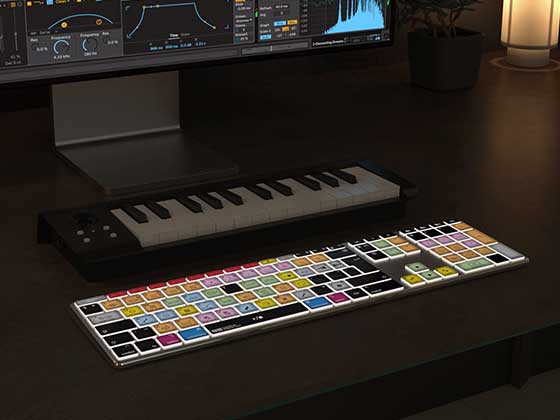
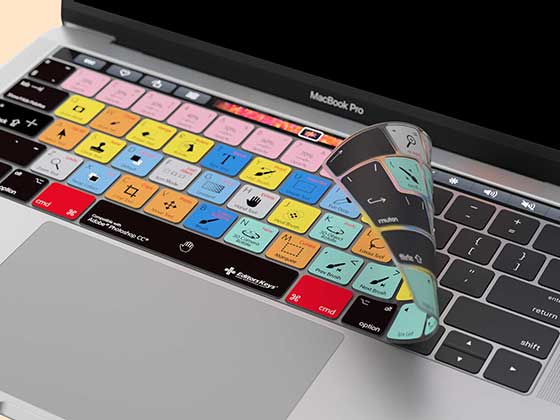
That is where Editors Keys shortcut keyboards and silicone keyboard covers can make a real difference. Instead of having to memorise every keyboard combination or constantly search through menus and shortcut lists, the most useful commands for your chosen music production software are clearly printed and colour-coded directly onto the keys. As you use the keyboard, the shortcuts become visual reminders, helping you gradually develop muscle memory and eventually use many commands without even thinking about them.
The range includes the AB10 Air wireless backlit shortcut keyboard and the AB10 Core wired USB-C backlit keyboard, giving you the choice between a flexible wireless setup or a direct wired connection. The AB10 Air can pair with up to three devices, while the AB10 Core is designed for producers who prefer a reliable USB-C connection without having to manage a battery. Both models feature adjustable backlighting, making them particularly useful in darker studio environments or during late-night production sessions.

If you already have a keyboard that you like, the Editors Keys silicone keyboard covers provide another way to bring the same shortcut-focused approach to your setup. The lightweight covers sit directly over your existing keyboard, displaying the relevant shortcuts while also helping protect the keyboard underneath. This can be a particularly useful option if you produce on a MacBook or already have a favourite Bluetooth or USB keyboard.
The real advantage is that Editors Keys products are designed to help you learn shortcuts while you work. Rather than stopping a production session to look up how to perform a particular command, you can simply glance down at the keyboard and continue. Over time, the repeated visual association between a key and its function helps turn unfamiliar shortcuts into natural parts of your workflow. The result is less time navigating menus and more time concentrating on the music.
Final Thoughts: The Best Free VST Plugins Can Take You a Long Way
The modern free plugin ecosystem is remarkably powerful. You can download a professional-quality synthesiser such as Vital, a huge creative reverb like Valhalla Supermassive, a sophisticated dynamic EQ in TDR Nova, a serious compressor in TDR Kotelnikov and an extensive collection of sampled instruments through the evolving LABS and Splice INSTRUMENT ecosystem without spending hundreds of pounds.
More importantly, these plugins cover fundamentally different parts of the production process.
Vital gives you a powerful sound-design engine for creating basses, leads, pads and electronic textures. Valhalla Supermassive gives you enormous reverbs and evolving delays for creating depth and atmosphere. TDR Nova provides detailed dynamic frequency control, while TDR Kotelnikov gives you a transparent and versatile compressor for shaping dynamics. Finally, LABS and Splice INSTRUMENT provide access to sampled instruments and sounds that can bring an organic or unusual character to your productions.
The biggest lesson, however, is that you do not need thousands of plugins to make great music. A handful of excellent tools, combined with a strong understanding of synthesis, EQ, compression, reverb and arrangement, will take you much further than an enormous collection of plugins that you barely understand.
And once you know your tools, speed matters. The less time you spend hunting through menus and searching for commands, the more time you can spend actually producing music. Editors Keys shortcut keyboards and silicone covers are designed around exactly that idea, putting your DAW's most important commands directly in front of you so that you can learn them, memorise them and eventually use them without thinking.
In music production, a better workflow does not just mean working faster. It means staying in the creative moment for longer.
Explore the full Editors Keys range of music production shortcut keyboards and covers
Last checked: August 2026. Plugin versions, operating-system compatibility and distribution methods can change, so always check the developer's official download page before installing a plugin or updating an existing production system.