

Achieving a professional mix requires precise control over how different audio elements interact. One of the most critical challenges studio engineers face is spectral conflict—when two instruments occupy the same frequency range and mask one another, resulting in a muddy, indistinct mix.
The primary solution to this problem is sidechaining.
Far from being a simple automated volume trick, sidechaining is a powerful routing technique used across music production, broadcast audio, and post-production to dynamically manage headroom and balance. Below, we break down the mechanics of sidechaining, its technical applications, and how professional engineers deploy it to achieve pristine separation.
What is Sidechaining?
In a standard signal processing chain, an effect processor (such as a compressor or noise gate) evaluates the internal audio signal of the track it is applied to. For example, a compressor inserted on a vocal track detects the amplitude changes of that vocal and reduces its gain accordingly.
Sidechaining alters the control signal architecture.

When you engage a sidechain input, you instruct the processor on Track A (the Target) to ignore its own audio signal and instead analyse the behaviour of an external audio source, Track B (the Trigger).
-
Internal Sidechaining: The processor filters its own track's signal (e.g., using a high-pass filter so a compressor ignores the low-end energy of a mix).
-
External Sidechaining: The processor responds entirely to a completely separate track's amplitude changes.

Technical Applications in Music Production
The most common implementation of this routing structure is Sidechain Compression, where the amplitude spikes of the trigger track instantly dictate the gain reduction of the target track.
1. Resolving Low-End Conflict (Kick and Bass)
The kick drum and sub-bass are the most notorious combatants in a mix, as both carry immense energy in the 20 Hz to 1Explained20 Hz range. If they strike simultaneously, their combined acoustic energy can easily distort the master bus or trigger master limiters prematurely.
By placing a compressor on the bass track and routing the kick drum into the external sidechain input, the bass momentarily ducks in volume the exact millisecond the kick transient hits.
This provides the kick drum with maximum transient clarity without requiring permanent, destructive equalisation on the bassline.
2. Sidechaining to a Noise Gate (Transient Reinforcement)
Sidechaining can also be applied to expanders and noise gates. A classic studio technique involves reinforcing a live snare drum with a synthesised tone or white noise layer to add top-end "crack" or bottom-end weight.
-
A noise gate is placed on a continuous white noise generator track, keeping it completely muted.
-
The live snare drum track is routed as the external sidechain trigger to that gate.
-
The moment the snare drum strikes, its transient forces the gate open, allowing a perfectly synchronised burst of white noise to blend with the natural snare acoustic.
3. Voiceover Ducking in Broadcast and Post-Production
In podcasting, radio broadcasting, and film sound design, background music or ambient soundscapes must naturally step out of the way of human dialogue. Rather than drawing tedious volume automation curves across a multi-hour project, engineers sidechain the music bed to the dialogue track. The background music automatically dips by 3Db to 6Db whenever a voice is detected, maintaining optimal speech intelligibility.

Step-by-Step Sidechain Routing Setup
While graphical interfaces vary across Digital Audio Workstations (DAWs), the routing topology remains universal:
-
Insert the Processor: Place a sidechain-capable compressor onto the channel strip of your target track (e.g., the Bass).
-
Assign the Sidechain Source: Open the plugin interface and locate the "Sidechain" or "Key Input" dropdown menu. Select the bus or individual track containing your trigger source (e.g., the Kick Drum).
-
Configure Compressor Parameters:
-
Threshold: Lower the threshold until the gain reduction meter registers attenuation exclusively when the trigger source plays.
-
Ratio: Set a moderate ratio (3:1 to 5:1) for transparent ducking, or a high ratio 10:1+) for aggressive pumping effects.
-
Attack: Set the attack time as fast as possible (0.1ms - 2ms) so the target track attenuates immediately upon the trigger's arrival.
-
Release: Adjust the release time to match the tempo of the project, ensuring the target track recovers smoothly before the next transient strike.
-
Optimising Studio Efficiency and Technical Workflows
Executing precise processing techniques like sidechaining requires analytical focus and a fluent command over your DAW software. When engineering complex mixes with dozens of sub-groups and auxiliary routing matrices, hunting through software sub-menus for routing paths can severely disrupt your technical and creative momentum.
To maintain an efficient engineering environment, professional producers utilise dedicated hardware control surfaces, including Editors Keys Shortcut Editing Keyboards and Keyboard Covers.
Speed Up Your Audio Production Workflow with Editors Keys
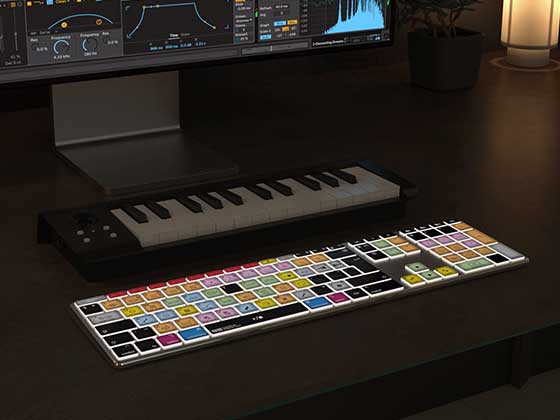
Understanding techniques like sidechaining is an important part of becoming a faster and more efficient producer, but knowing your DAW shortcuts can have an equally large impact on your workflow. Editors Keys shortcut keyboards and keyboard covers are designed to help producers, musicians and audio engineers work faster by placing essential DAW shortcuts directly onto the keys.
Instead of constantly searching through menus or trying to memorise hundreds of keyboard combinations, you can instantly see the commands you need while working. Editors Keys creates dedicated shortcut keyboards and silicone keyboard covers for many of the most popular audio production applications, including Logic Pro, Cubase, Ableton Live, Pro Tools and more.

Whether you are recording, editing, mixing or mastering, having your shortcuts visible can help you:
- Edit projects faster.
- Spend less time navigating menus.
- Learn shortcuts naturally while working.
- Improve your overall workflow.
- Stay focused on creativity rather than technical processes.
For beginners, shortcut keyboards make learning a DAW much easier. For experienced producers, they provide a faster and more efficient way to access commonly used commands during busy production sessions.

Engineered for DAW Performance
-
Comprehensive Shortcut Visualisation: Editors Keys custom keyboards map out the complete ecosystem of hotkeys for major industry-standard DAWs, including Avid Pro Tools, Apple Logic Pro, Ableton Live, FL Studio, and Steinberg Cubase.
-
Workflow Optimisation: Visually colour-coded key groups allow you to instantly access mixing windows, toggle automation lanes, split regions, and manage routing paths without touching a dropdown menu, accelerating manual editing workflows by up to 40%.
-
Tactile and Protective Solutions: For studios utilising native hardware, Editors Keys designs precision-moulded silicone keyboard covers. These covers provide identical shortcut maps directly over your existing keys while offering a layer of protection against the everyday hazards of a busy control room environment.
By mitigating the friction of software navigation, engineers can dedicate their cognitive focus entirely to critical listening, precise dynamic adjustments, and pristine mix architecture.
Explore the complete range of professional DAW shortcut keyboards and covers at Editors Keys.